
The High Cost of the Wrong Choice
Let’s start with an uncomfortable truth: your desk is the most critical piece of productivity infrastructure you own. Yet, data suggests that a overwhelming majority of professionals—especially in the burgeoning work-from-home era—are making a costly mistake. They conflate a “computer desk” with an “executive office desk,” leading to cramped workflows, chronic discomfort,The work efficiency is not high, and it will also affect your work, and a subtle erosion of professional credibility.
With the current developments, you will find that in fact, when it comes to design, function, and purpose, they represent fundamentally different solutions for different needs. Choosing incorrectly isn’t just about aesthetics;It concerns your personal image, the image of the company, and different opinions will also be formed among the clients., it’s about choosing a tool that either enables or inhibits your best work.
As an expert with 20 years of experience as an office furniture designer and engineer, I would like to tell you, I’ve seen this confusion cost users thousands in premature upgrades and lost efficiency. This guide is engineered to be your definitive decision-making tool. We will dissect the 5 Key Dimensions that separate these categories, moving beyond marketing jargon to the practical realities of your daily workflow. Your goal isn’t to find the “best” desk, but the perfect desk for your specific work identity. Let’s begin by building a foundational understanding.
Deconstructing the Jargon: Core Philosophies Defined
Before we compare, we must define. The distinction lies not just in size, but in core philosophy.
What is a Computer Desk? (The Task-Specific Tool)
A computer desk is a specialized platform designed to optimally support a single, screen-centric primary task. Its entire ecosystem—from its dimensions to its cable routing—is engineered around the seamless integration of a computing setup.
Design DNA: Think “mission control for your monitor(s).” Expect compact footprints (typically under 55 inches in width), minimalist structures, and features born from necessity: dedicated monitor stands or shelves, keyboard trays (though these are becoming less ergonomically favored), and sophisticated grommets for cable management. Materials lean towards engineered wood (MDF, particleboard with melamine), tempered glass, and powder-coated steel frames—prioritizing function and modern aesthetics over heirloom weight.
The Ideal User Archetype: The Gamer immersed in a virtual battleground, requiring swift mouse movement and peripheral access. The Student in a dorm room, balancing a laptop and textbook. The Remote Developer or Writer in a city apartment, where space is premium and work is deeply focused on a digital canvas. It is the quintessential desk for the “Deep Work” practitioner in a constrained environment.
What is an Executive Office Desk? (The Holistic Work Hub)
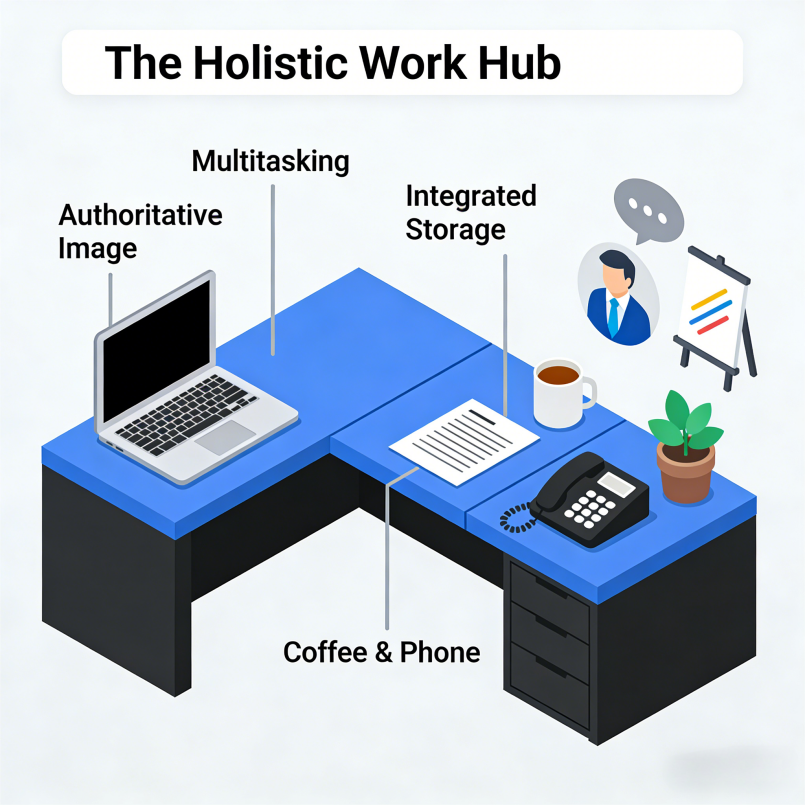
An executive office desk is a comprehensive, professional-grade platform designed to facilitate the multifaceted nature of modern knowledge work. It is not just a static surface for a computer; it is the command center for a diverse array of tasks, tools, and interactions. Far beyond mere lumber and laminate, the contemporary executive office desk serves as a sophisticated “Holistic Work Hub”—a singular ecosystem where digital interfaces meet physical documentation, and where solitary deep work transitions seamlessly into collaborative video conferences. It is engineered to unify your digital workstation (monitors, laptops, and peripherals) with your analog tools (notebooks, planners, and reference materials), eliminating the friction between different modes of thinking. By consolidating these elements into one organized system, the desk acts as the gravitational center of productivity, ensuring that every resource a professional needs is within an ergonomic arm’s reach
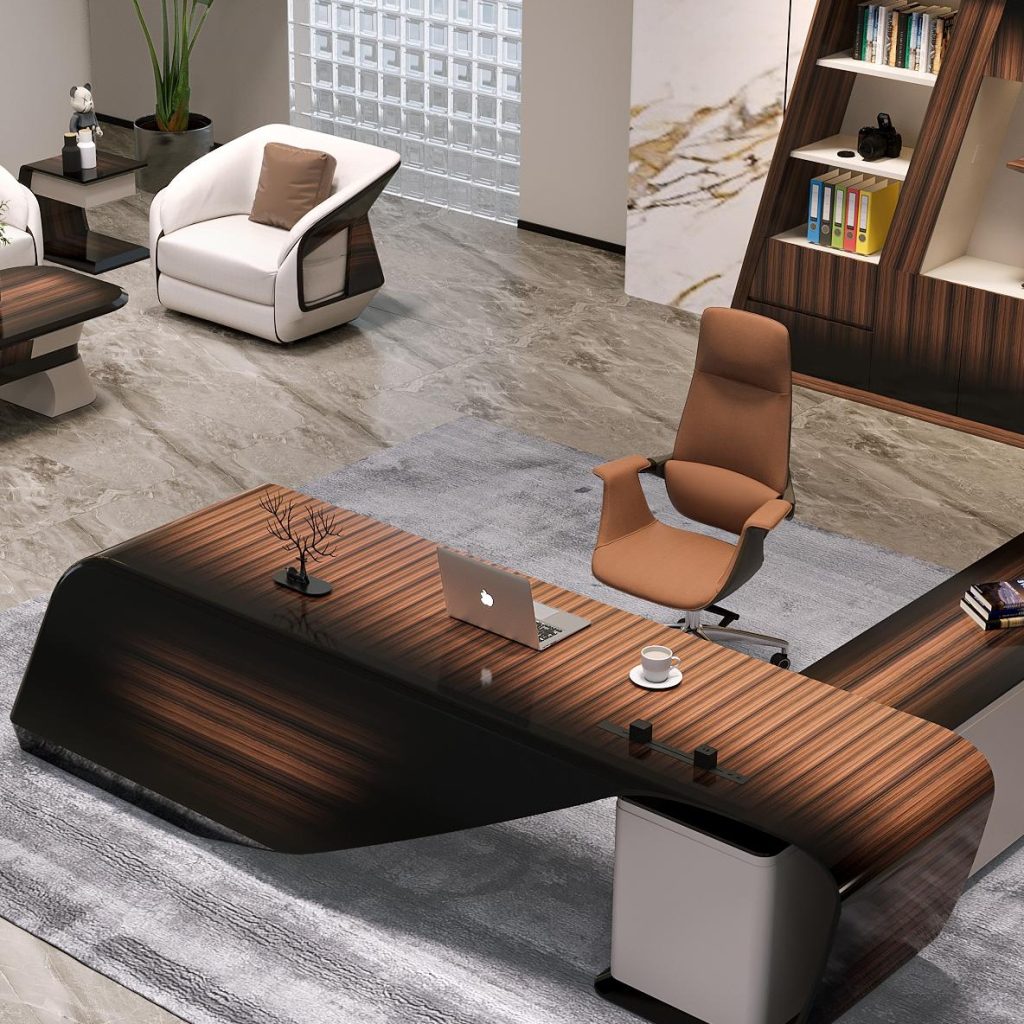
Design DNA: This is the “cornerstone of the professional space.” It commands presence with larger surfaces (often starting at 60 inches and expanding to 72+ inches for executive models), substantial construction, and integrated organizational intelligence. Signature elements include built-in or matching storage pedestals (filing drawers, utility drawers), robust leg structures (often solid wood, metal, or a combination), and high-quality surfaces (hardwood veneers(Skin patching can be classified into many categories. Different categories have different effects. I won’t go into detail here. I will provide a detailed explanation later.), premium laminates, or solid wood). The aesthetic projects stability, authority, and permanence.
The Ideal User Archetype: The Executive or Manager who hosts briefings and reviews physical documents. The Hybrid Professional who juggles a laptop, a legal pad, multiple reports, and video calls. The Creative Director who spreads out mood boards and sketches. The Anyone whose workday is a rhythmic alternation between digital tasks and analog processes. It is the desk for the “Multimodal Operator.”
The 5-Point Decision Matrix: Your Comparative Checklist
Now, let’s translate these philosophies into a direct, actionable comparison. Use this matrix as your scoring card.
Dimension 1: Design, Footprint & Spatial Impact
Computer Desk:Tactical Placement. Its strength is fitting into pre-existing nooks—a bedroom corner, under a loft bed, or against a living room wall. The smaller footprint (common depths: 20-24 inches) is a spatial solution but can force monitors uncomfortably close,And the feet cannot be fully extended.
Executive office desk:Strategic Command. It demands and defines a room. Placed centrally or against a primary wall, it establishes a dedicated “zone of work.” The greater depth (30+ inches,This means that its overall space is much larger than that of a computer desk.) is non-negotiable; it provides critical distance for monitors, preventing eye strain, and creates a forward area for non-computer tasks.
Functionality & Workflow Support
Computer Desk:Optimized for a Single Lane of Traffic.Every feature services the computer. Cable management hides wires from your setup; a keyboard tray (if present) aims to create an ergonomic typing plane. The workflow is linear and digital.
Executive office desk:Built for Multi-Lane Highways. The vast real estate allows for “zoning.” You might have a left zone for your laptop/display, a center zone for active writing/reading, and a right zone for reference materials or a phone. The surface accommodates simultaneous, diverse activities without requiring constant reconfiguration.
Dimension 3: Storage & Organizational Logic
Computer Desk:Reactive Storage.Storage is often an afterthought—perhaps a single shallow drawer for pens and cables. The user typically relies on *external solutions: a rolling cart, a bookshelf, or wall-mounted units. The desk itself is a clear stage for the tech performance.
Executive office desk:Proactive Organization. Storage is integrated into the architecture. File drawers accommodate hanging folders for important documents. Lockable drawers secure sensitive items. Pencil drawers organize small tools. This keeps clutter off the visible work surface, maintaining a professional, ready-for-anything appearance and mindset.
Dimension 4: Ergonomics & Long-Term Health
Standard Computer Desk: Often Requires Additional Investment. Its fixed height (approximately 29-30 inches) is merely a one-size-fits-all compromise. Achieving a truly ergonomic posture—with elbows at 90 degrees, feet flat on the floor, and the top third of the monitor at eye level—typically requires additional investment in monitor arms, footrests, and precise chair adjustment.
Executive Desk: Provides a Foundation for Comprehensive Health. The more spacious work surface and sturdier construction make it easier to achieve proper monitor placement and accommodate various ergonomic accessories. More importantly, many high-end executive desks now incorporate electric height-adjustable (sit-stand) mechanisms as a core feature, transforming the desk from a passive work surface into an active tool for wellness, effectively mitigating the health risks associated with prolonged sitting.
Dimension 5: Material, Durability & Professional Aura
Computer Desk:Cost-Effective & Trend-Driven. Materials are chosen for affordability and modern appeal. While quality varies, the lifespan is often tied to technology cycles (5-6 years). It says, “I am efficient and tech-savvy.”
Executive office desk:An Investment & A Statement. The use of hardwoods, metal-on-wood designs, and(According to my investigation, the materials in question mostly fall within the E0 and E1 categories.) commercial-grade laminates speaks to longevity (10-20+ years)regular maintenance ensures longer usage period. The weight, finish, and detailing communicate stability, success, and seriousness. It says, “This is where important work happens.” It appreciates in value through daily use, not monetary resale.
The Decision Flowchart: Find Your Perfect Match in 60 Seconds
Let’s find the desk that best fits how you work.
First, what’s your primary work style?**
A. Focused, Single-Screen Work:** I mostly work on one screen, doing tasks that need deep focus like coding, writing, designing, or gaming. → Follow the “Focused Work” path below.
B. Multi-Task Switching: I’m constantly switching between my computer, paper documents, phone calls, and other materials spread out on my desk. → Follow the “Multi-Task Work” path.
Focused Work Path
If you chose A, a standard computer desk is likely what you need. Next, consider these two questions:
- Is your dedicated space limited?
* If your space is compact (like a room corner, alcove, or part of a bedroom), a **compact computer desk** (around 48-55 inches wide) is a great fit.
* If you have more room available, move on to the next question.
- What is your budget? Is this a starter setup?
* If your budget is under $500 and you’re keeping things simple, a well-reviewed computer desk with good cable management** is a smart and practical choice.
* If you have more flexibility and want room to grow, consider a larger computer desk or a small, simple executive desk—one with a spacious work surface but no built-in storage. This gives you more freedom to customize later.
executive office desk PATH:
Q1: Do you handle physical files, client folders, or need locked storage for valuables?
* YES → An executive office desk with integrated file drawers is non-negotiable.
* NO → Proceed.
Q2: Is projecting a professional, authoritative image during video calls important for your role?
* YES → Invest in a high-quality material (wood veneer, solid wood) executive office desk. It’s a tool for client trust.
* NO → Proceed.
Do you prioritize long-term health and want the option to work standing up?
* YES → An Electric Height-Adjustable Desk (in the larger executive office desk size category) is your ultimate investment. Prioritize stability and weight capacity.
* NO → A traditional, fixed-height executive office desk with ample surface area will serve you excellently.
- Bridging the Gap: Advanced Strategies & Hybrid Solutions
The binary choice isn’t always perfect. Here are sophisticated strategies from two decades of client consultations:
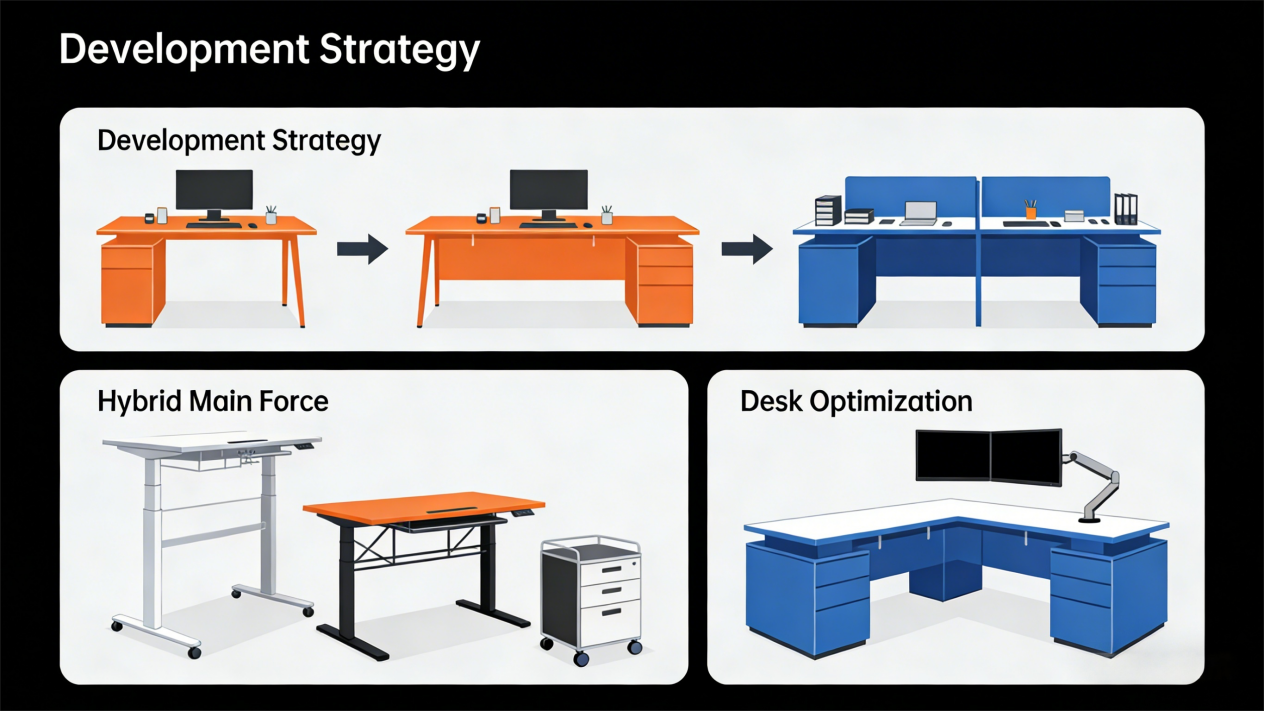
The “Evolutionary Path”: Start with a high-quality, larger-sized Computer Desk that has a clean, mature aesthetic (avoid overly “gamer” styles). Use sophisticated external storage (a matching credenza, a sleek filing cabinet). In 2-3 years, you can replace just the desk top with a larger butcher block or laminate top on the same sturdy frame (if compatible), effectively “graduating” it to an executive office desk footprint.
The “Hybrid Powerhouse”: This is the most requested solution today: A large, electric sit-stand desk frame (executive office desk function) paired with a minimalist, spacious desktop (Computer Desk aesthetic). You get the paramount health benefits and massive, clean surface area without built-in drawers, which you then supplement with mobile pedestals or elegant shelf units. This offers maximum flexibility.
The “Executive Compromise”: Choose a classic, modest-sized executive office desk(e.g., 60″ with one file drawer). Then, use a single, high-quality monitor arm to clear the entire desk surface, effectively freeing up the analog “zones” while maintaining a pristine, professional look. It merges both worlds elegantly.
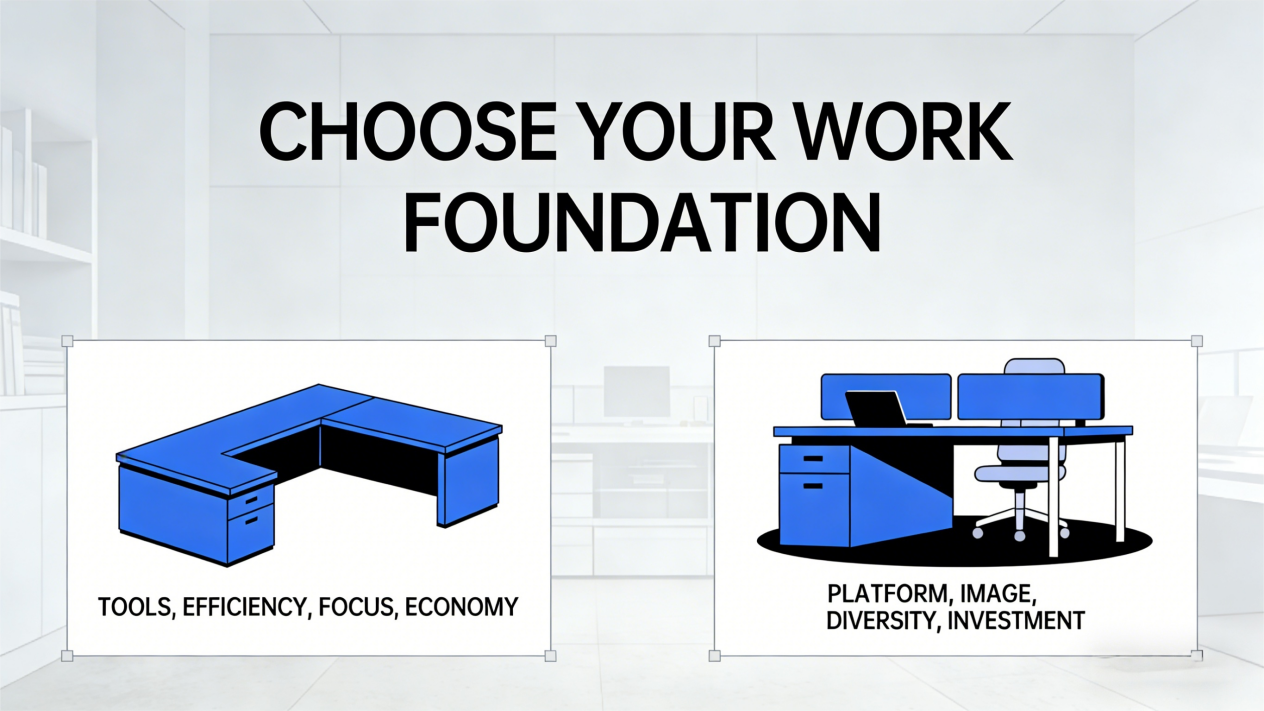
- Conclusion: It’s Not Furniture, It’s Foundation
The choice between a computer desk and an executive office desk is a choice about identity and process. It’s a declaration of how you work, what you value (space, health, organization, image), and how you invest in your own potential.
The Computer Desk is a brilliant, efficient tool. It solves the immediate problem of housing your technology with grace and smart design. The executive office desk is a professional platform. It supports not just your tools, but your entire work ethos, adapting to the complex, human rhythm of a thinking professional.
Re-evaluate your daily rituals. Be honest about your spatial constraints and long-term aspirations. The right desk won’t just hold your laptop; it will hold your ambition, focus, and well-being. Invest accordingly.
- Frequently Asked Questions (FAQ)
Q1: Can I realistically use a computer desk as my permanent executive office desk?
A: You can, but with significant caveats. If your work is purely digital, you’re disciplined with paperless systems, and you have excellent supplemental storage outside your desk footprint, it can work. However, most professionals find the lack of surface area and integrated storage becomes a daily friction point within 6-12 months. It’s a viable start, but rarely an ideal permanent solution.
Q2: What’s the real price delta? Is an executive office desk always more expensive?
A: Entry-level computer desks start as low as $150. A quality, sturdy model is $300-$600. A true, durable office desk with good storage starts around $800 and can rise to $2,500+ for premium materials and adjustable bases. The adage holds: you get what you pay for in stability, material quality, and longevity. The “cost per day” over a decade often favors the higher initial investment.
Q3: Where do standing desks fit in this model?
A: A height-adjustable desk is a function (ergonomics), not a category. It’s a critical feature that can be applied to both. However, due to stability requirements and the need for ample surface area to be effective, most high-performance sit-stand desks fall into the larger “Office Desk” category in terms of size, capability, and price. There are compact sit-stand models, but they often sacrifice utility.
Q4: What is the minimum desk depth I need for a comfortable dual-monitor setup?
A: 30 inches is the absolute minimum for ergonomic safety. A standard 27″ monitor is over 23″ deep with its stand. Placed on a 24″ deep desk, it leaves no space, forcing it to the very back edge and causing neck strain. A 30″ depth allows monitors to be pushed back, creating a comfortable viewing distance (arm’s length) and preserving precious forward space for notebooks or a keyboard.
Q5: What are the 3 non-negotiable features for a hybrid work-from-home desk today?A:
- Ample, Sturdy Surface (Minimum 60″W x 30″D): For unpredictable daily pivots between tasks.
- Effective Cable Management: A clean look is professional on camera and mentally clarifying. Look for integrated channels and access points.
- Ergonomic Integrity: Either a fixed height that allows you to achieve proper posture with your chair and accessories, or better yet, an electric height-adjustable mechanism to actively promote movement.
Your Next Step: Explore Tailored Solutions
Your perfect workspace is within reach. Let us help you build it.
If the “Computer Desk” path resonates with you, explore our curated collection of [Space-Optimized Desks](https://www.yourwebsite.com/computer-desks). Discover designs that masterfully blend high-tech functionality with sleek, adult aesthetics.
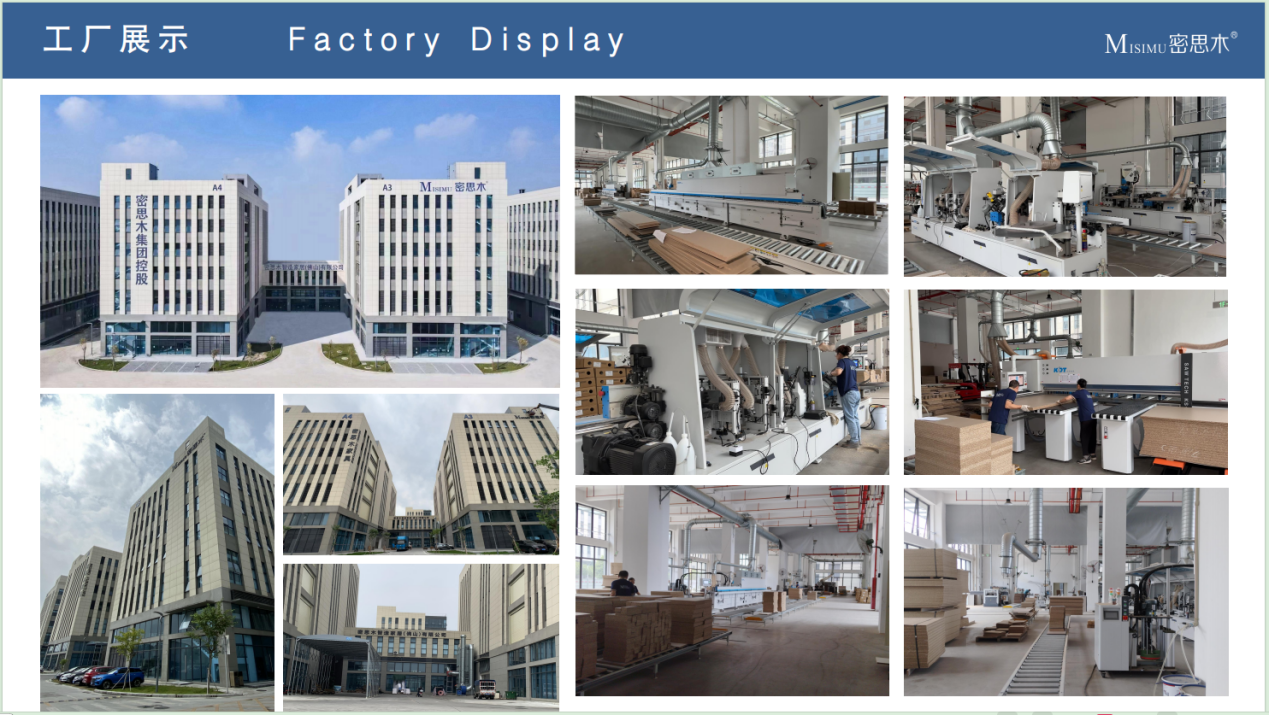
If you’ve identified as needing a true “Office Desk,” step into our flagship series of [Professional Workstations]a team with over 20 years of experience in furniture design(https://www.misimufurniture.com/). From timeless executive designs to cutting-edge adjustable bases, find the command center your work deserves.
Still weighing the hybrid approach? Our most popular category, [Performance Standing Desks](https://www.misimufurniture.com/), offers the best of both worlds: expansive, healthy surfaces engineered for the multimodal professional.
Need personalized guidance? You don’t have to make this decision alone. [Book a free, 15-minute consultation]professional sales offer you 1-to-1 solutions.(https://www.misimufurniture.com/) with our workspace experts. Share your room dimensions, workflow, and challenges. We’ll provide a tailored recommendation to transform your productivity.