I’ve been in the office furniture business for 20 years.
Over these years, I’ve seen many clients make the same mistakes:
-A new desk that looks great, but after two years the drawers start sticking
-A filing cabinet that bends in the middle after you fill it with files
-An office that still smells strange six months after renovation
These problems are annoying enough in a regular workspace. But when they happen to an expensive luxury executive desk, it’s even worse. This desk is not just for work—it also shows your company’s image.Most of these problems come from one thing: choosing the wrong board materials.In this article, I want to share what I’ve learned over 20 years. No complicated talk, just practical advice. Read this before you buy your next luxury executive desk.

You see many names in the market: “solid wood particle board,” “high-density fiberboard,” “eco-board”… It’s easy to get confused.
But here’s the truth: there are only two main types of board used in office furniture.
Type 1: Wood-Based Boards (The “Main Force” in Offices)
More than 90% of office furniture uses wood-based boards. Not because companies want to save money, but because these boards really work best for offices.
Common good points of wood-based boards:
~Stable – they don’t expand or shrink with weather changes
~Surface is hard and easy to clean
~Can be made in any size
~Good value for money
Wood-based boards have three main kinds. Each has its own strength:
- Particleboard – The Reliable Worker
Best for: Filing cabinets, regular desks, cabinet boxes
Good points: Holds weight well, stable structure, good price
Not so good: Can’t make fancy shapes, not good if water sits on it for long
What to check when buying: Choose boards from big factories with high density. Good particleboard holds screws tight for ten years.
- MDF (Medium-Density Fiberboard) – For When You Want Fancy Shapes
Best for: Shaped doors, curved desktops, decorative parts
Good points: Very smooth surface, can make any shape you want
Not so good: Doesn’t hold screws as well, swells if water gets in
What to check when buying: Look at the cut edge. Good MDF cuts smooth with no fuzz. It’s fine for decorative parts on a luxury executive desk, but don’t use it for heavy-load parts.
- Multilayer Board (Plywood) – The Strong One
Best for: Desk frames, shelves that hold heavy things
Good points: Very strong, won’t bend even with heavy weight over time
Not so good: Has many layers. If the glue is bad, can be a problem
What to check when buying: Don’t just think “multilayer board = bad.” Good quality multilayer board now uses non-formaldehyde glue and can reach the highest levels. The key question is: What kind of glue do you use?
Type 2: Solid Wood – The “Image Ambassador”
Best for: Desktops, reception desks, visible parts in executive offices
Good points: Natural wood pattern, feels warm, can be sanded and refinished
Not so good: Expensive, needs care, can crack in dry weather
What to check when buying: Many people think “solid wood is always best.” Not true. Big solid wood boards often crack. Real wood veneer + stable base board gives you the look without the headache. I’ve seen too many clients pay a lot for a pure solid wood luxury executive desk, and the top cracks the next year.
My advice: If you want the real wood look, choose real wood veneer. Good veneer is 1.2mm thick or more. It lasts 10+ years and you can sand and refinish it.
Part 2: Board Brands – What You Can’t See Matters
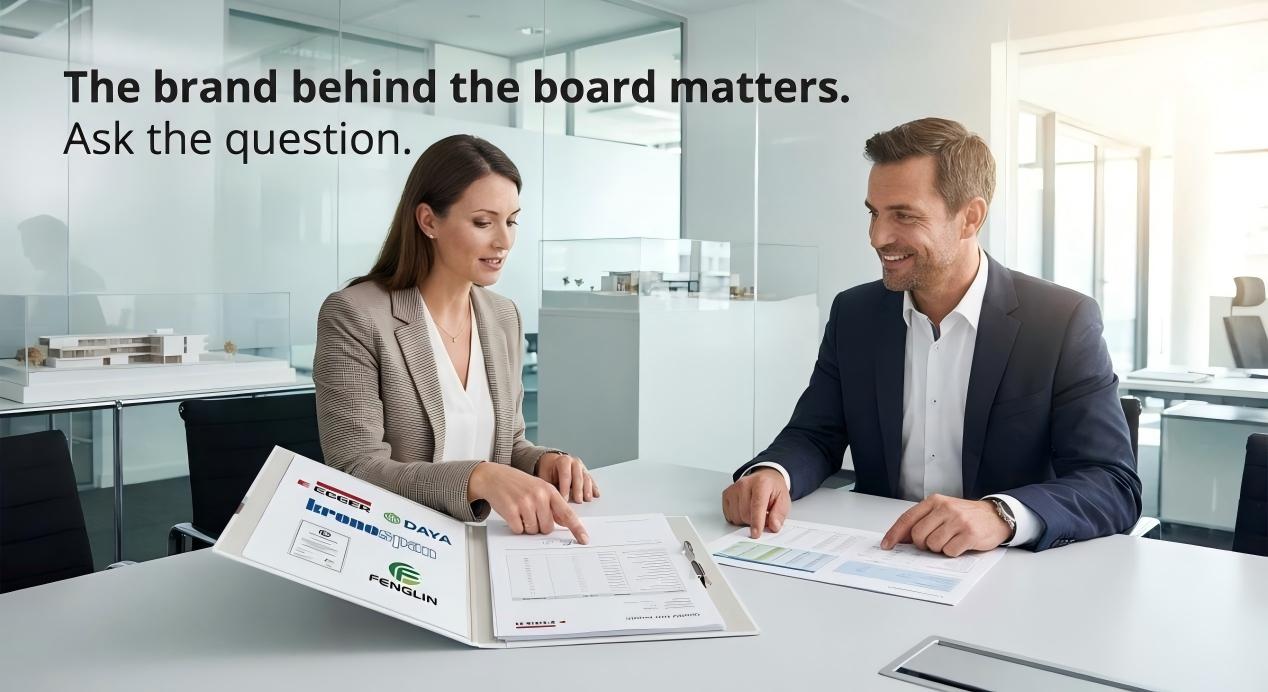
Now let’s talk about something many people forget: Who made the board? The same type of board can be very different quality depending on who makes it.
Board brands worth remembering:
International brands: Egger, Kronospan, Pfleiderer
Top Chinese brands: Daya, Fenglin, Ningfeng, Furen
Why do brand names matter? Because these companies have good raw materials, strict production control, and proper test reports. Next time you buy a luxury executive desk, ask this question: “What brand of board do you use?” If they answer quickly and clearly, they know their product. If they say “all good boards” but no name, be careful.
Part 3: Certifications – Trust Numbers, Not Words
This is where things can get tricky. And it’s the most important part. A desk can last ten years, but bad air makes you feel bad every day.
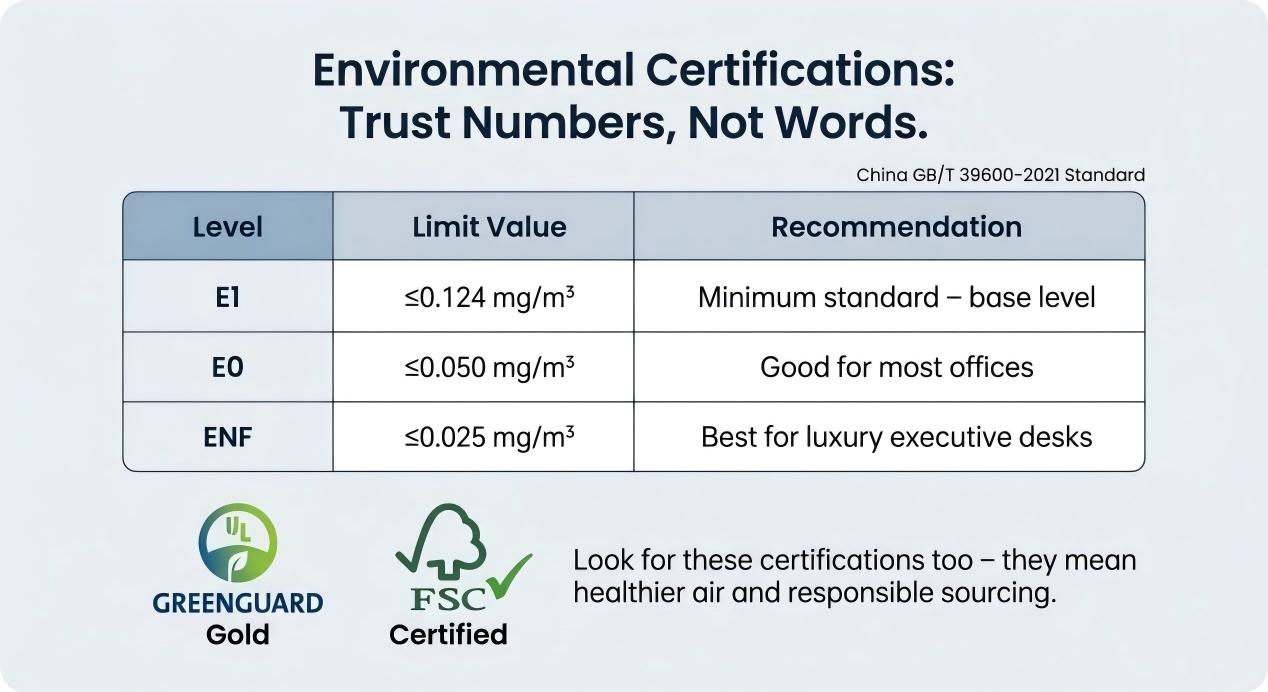
First: Formaldehyde
China’s national standard GB/T 39600-2021 puts boards into three levels:
| Level | Limit Value | What It Means |
| E1 | ≤0.124 mg/m³ | National minimum standard. Must reach this. |
| E0 | ≤0.050 mg/m³ | Twice as strict as E1. Good enough for most needs. |
| ENF | ≤0.025 mg/m³ | Highest level in China now. |
My advice:
Regular workstations: E0 is enough
Luxury executive desk: At least E0. ENF is even better.
If budget allows, choose boards with MDI glue or “no added formaldehyde.”
But Formaldehyde Is Not the Only Thing
Formaldehyde is just one bad thing in indoor air. There’s a big group called VOCs (Volatile Organic Compounds) . These also cause smells and health problems. This is where another certification matters: GREENGUARD (especially Gold level). It tests all VOCs, not just formaldehyde.
And There’s FSC
If you care about the environment, look for FSC certification. It means the wood comes from forests that are managed responsibly, not cut down without care.
Simple guide:
Budget choice: E1 (but this is minimum, not best)
Good choice: E0 + brand name boards
Best choice: ENF + GREENGUARD Gold + FSC
Part 4: How to Build a Good Luxury Executive Desk
OK, enough talk. Let’s get practical. If you want a luxury executive desk that really lasts, looks good, and is healthy, here’s a good way to choose:
The Desktop: Look Good and Last Long
Best combo: Real wood veneer (walnut/cherry/oak) + high-density multilayer board base
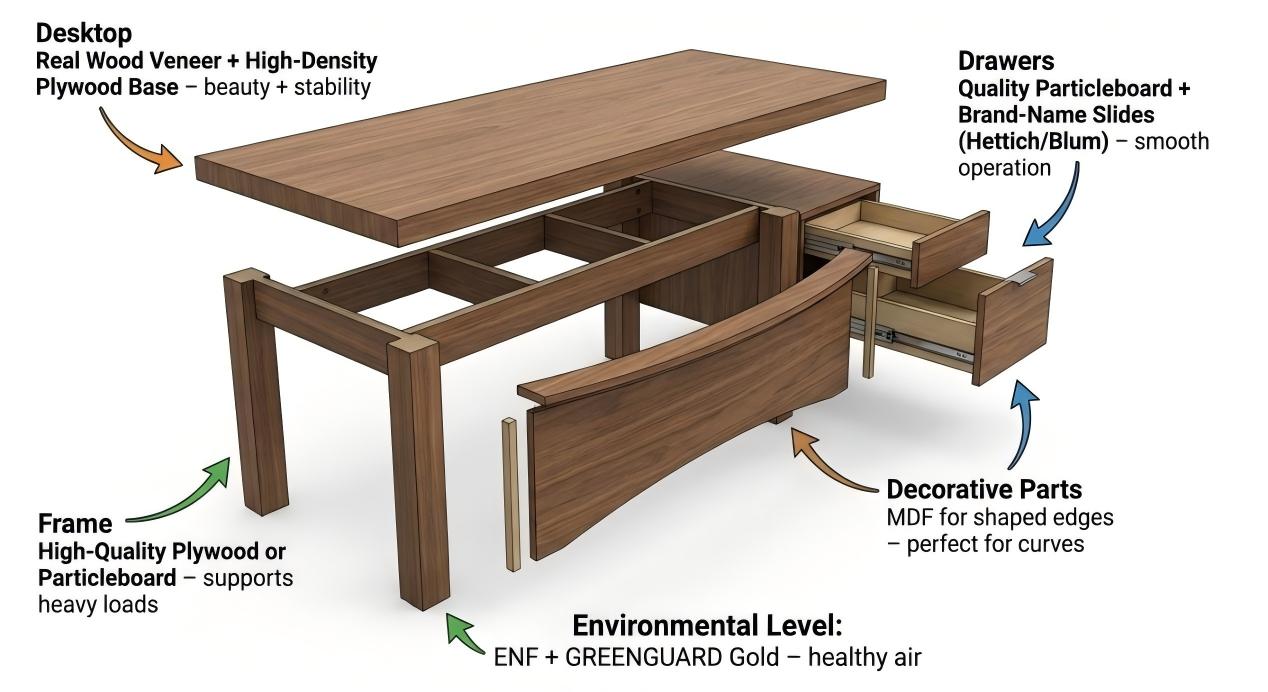
Why:
- Real wood veneer gives you the natural, expensive look
- Multilayer board base makes sure the top doesn’t bend
- You can make big desktops without visible seams (unlike solid wood)
The Frame and Heavy-Load Parts: Don’t Go Cheap
Best choice: Good quality multilayer board or thick particleboard
Why: This desk will hold computers, files, and your arms every day. If the frame is weak, it will wobble in three years.
Drawers and Storage: Good Hardware Matters
Best choice: Good particleboard + brand name drawer slides
Why: Particleboard is best value for cabinets. But how smoothly drawers open depends on the hardware. Ask what brand of drawer slides they use (Hettich, Blum, Grass are good names).
Decorative Parts: The Icing on the Cake
Best choice: MDF for shaped parts
Why: If you need curved edges or carved details, MDF is best. But don’t use MDF for parts that carry heavy weight.
Level: Better Safe Than Sorry
Best choice: ENF level + GREENGUARD Gold
Why: Executive offices often have doors closed for meetings. Air quality affects how people think and feel. A little more money for better is worth it.
Part 5: My Honest Opinion – Good Materials Save You Trouble
After 20 years in this business, here’s what I truly believe:
Cheap boards lead to expensive lessons.
I’ve seen clients save a few thousand yuan on boards that just meet the minimum. Six months later, the office still smells, employees complain, and they spend tens of thousands on air cleaning. Plus they lose trust. I’ve also seen clients buy “pure solid wood” luxury executive desk, and the top cracks when winter heating turns on. The repair guy says “solid wood does that” and walks away. So here’s my point:
Good materials are not the most expensive ones. They’re the ones that fit your needs. Know what you need. Understand the different boards. Check the numbers. Do these three things, and your desk will serve you well for ten years.
One Last Thing (Also True)
If you’re looking for a luxury executive desk for your office, feel free to talk to Misimu. We don’t just sell desks. We want to understand: How does your team work? What style fits your space? How can you get the best value for your budget? Twenty years in this business—we don’t know everything, but we can help you avoid the mistakes we’ve seen. A good desk should not be a headache.